
Predictive Service Strategy: Why Most Programs Fail and How to Build Readiness

Executive Summary
Predictive service initiatives fail not because of technology, but because organizations skip the required mindset shift.The move from reactive to preventive thinking is the true foundation of transformation.Technology, process, and people must evolve together.Without ownership and aligned KPIs, predictive tools remain underused.Predictive success begins with leadership maturity, not software.
A strong predictive service strategy requires more than analytics deployment. It demands organizational readiness.
Across industries, organizations say the same thing:“We are moving toward predictive service.”
A strong predictive service strategy requires more than analytics deployment. It demands organizational readiness and disciplined execution.
The business drivers are clear. Customers demand uptime, not just fast response. Margins are tightening. Skilled technicians are harder to find. Data is more accessible than ever.
The technology exists.The tools are available.
Yet many predictive initiatives stall before delivering measurable impact.
Not because analytics are weak.But because the organization never completed the most critical transformation:
The shift in mindset.
Predictive Service Begins with Ownership
Service maturity follows a clear and structured evolution:
Reactive → Preventive → Predictive → Prescriptive
The most critical transition is not from preventive to predictive.
It is from reactive to preventive.
Reactive organizations allow failures to dictate priorities.Preventive organizations take control and define maintenance discipline proactively.
That shift represents a fundamental change:
From being controlled by eventsTo control operational risk.
If this transition is incomplete, predictive systems become an advanced layer built on unstable foundations.
Predictive capability cannot compensate for a reactive culture.

The Three Pillars Must Move Together
Predictive service or predictive maintenance strategy stands on three interconnected pillars:
TechnologyProcessPeople
An imbalance between these pillars is the most common reason for failure in the field service transformation.
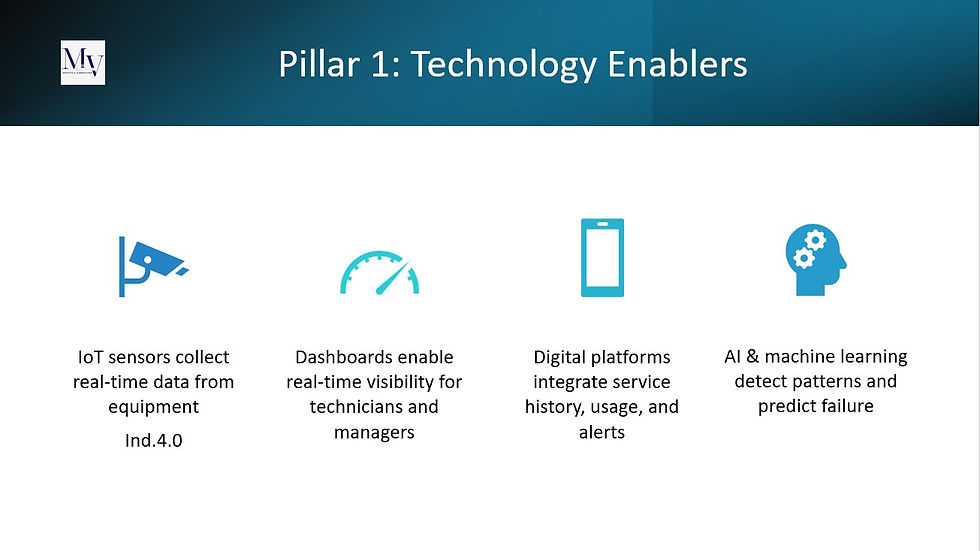
Technology
Sensors, monitoring systems, AI models, dashboards.
They detect early signals and forecast risk.
But detection alone does not create value.
Value emerges only when signals trigger structured action.
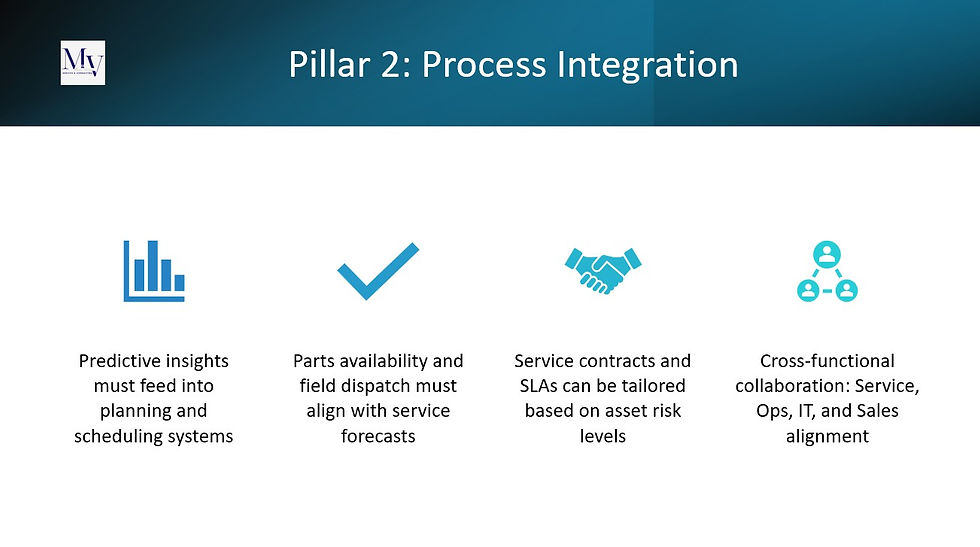
Process
Who owns the alert?What decision must be made?Within what timeframe?Who has authority to intervene?
If predictive insights do not integrate into operational workflows, they remain informational, not transformational.
Predictive service requires redesigned maintenance planning, spare parts strategy, and cross functional coordination.
People and Culture
This is the decisive factor.
Field teams must trust data.Operations must accept planned intervention before visible failure.Leadership must reward prevention, not only recovery speed.
If KPIs still reward reactive heroics, predictive programs will quietly lose momentum.
Technology adoption is rarely technical resistance.It is behavioral resistance.

The Predictive Readiness Model
Successful predictive transformation requires structured readiness across three dimensions:
Leadership and ownership alignment
Operational process integration
Technology enablement built on preventive foundations
The Predictive Readiness Model evaluates whether these dimensions are mature enough to support a sustainable predictive service strategy.
Without readiness, predictive tools become underutilized monitoring systems.With readiness, predictive capability becomes scalable and sustainable.
The Predictive Readiness Model provides a structured framework for implementing a sustainable predictive service strategy.
Predictive success is not about installing sensors.It is about aligning leadership, process discipline, and decision authority.
How to Assess Your Predictive Readiness
Before launching or scaling predictive initiatives, organizations should ask:
Do we have a clearly defined business objective tied to predictive outcomes?
Have we completed the transition from reactive to disciplined preventive execution?
Is ownership of alerts clearly defined across functions?
Are KPIs aligned with prevention value, not only downtime recovery?
Do field and operations teams trust data driven interventions?
Is leadership prepared to support planned interventions that may temporarily interrupt production?
If the answer to several of these questions is uncertain, the organization is not facing a technology gap.It is facing a readiness gap.
Closing that gap determines whether predictive initiatives deliver ROI or stall quietly.
Why Programs Fail
In real industrial environments, predictive programs often fail due to:
Undefined business objectivesAmbiguous ownershipMisaligned performance metricsTool overload without process redesignCultural resistance to preventive interventionUnrealistic ROI expectations
Notice that none of these are algorithm limitations.
They are leadership and structural barriers.
The Real Turning Point
In multiple environments, predictive tools were technically operational but strategically underused.
The breakthrough occurred when performance measurement shifted to include prevention effectiveness, not just failure recovery.
That shift altered behavior.
Technology enabled visibility.Process structured response.People sustained change.
Predictive capability emerged only after mindset alignment.
Common Executive Misconceptions About Predictive Service
Even experienced leadership teams often approach predictive transformation with assumptions that limit success.
Misconception 1: Predictive is primarily a technology investment.In reality, predictive service is an operating model shift. Technology enables it, but leadership alignment and process redesign determine its effectiveness.
Misconception 2: More data automatically creates more value.Data without structured decision ownership creates dashboards, not outcomes. Value emerges when insights trigger disciplined action.
Misconception 3: Predictive initiatives should deliver immediate ROI.Predictive maturity is built in stages. Early phases require behavioral and structural adjustments before measurable financial impact stabilizes.
Misconception 4: Field teams resist technology.In most cases, resistance reflects unclear accountability or misaligned KPIs, not rejection of innovation.
Organizations that recognize and address these misconceptions accelerate transformation. Those that ignore them often mistake structural friction for technological failure.
Final Thought
Predictive service is not a software upgrade.
It is a maturity evolution and a leadership decision.
If the mindset foundation is not solid, the transformation will stall.
But when ownership, process, and culture align, predictive and prescriptive models become powerful engines of operational control and business value.
Organizations ready to strengthen their predictive service strategy and evaluate their Predictive Readiness and structure their next stage of service maturity can explore this transformation approach further at MV Service & Consulting.
About MV Service & Consulting
At MV Service & Consulting, we support industrial organizations in designing and executing structured service transformations, from reactive environments to predictive and prescriptive maturity.
Our approach is built on real field experience across industrial equipment, injection molding systems, and global service organizations. We combine strategic clarity with operational execution, ensuring that leadership alignment, process redesign, and technology integration move forward together.
Through proven methodologies such as the Predictive Readiness Model, we help organizations assess maturity gaps, define realistic roadmaps, and implement transformation initiatives that deliver measurable operational and financial impact.
Our methodology is shaped by hands-on industrial execution. From complex refurbishment programs and OEE improvement initiatives to cross-site service transformations, we translate strategy into measurable operational results, not theoretical frameworks.
Predictive service is not a theory. It is a structured journey.And with the right framework and discipline, it becomes achievable.


Comments